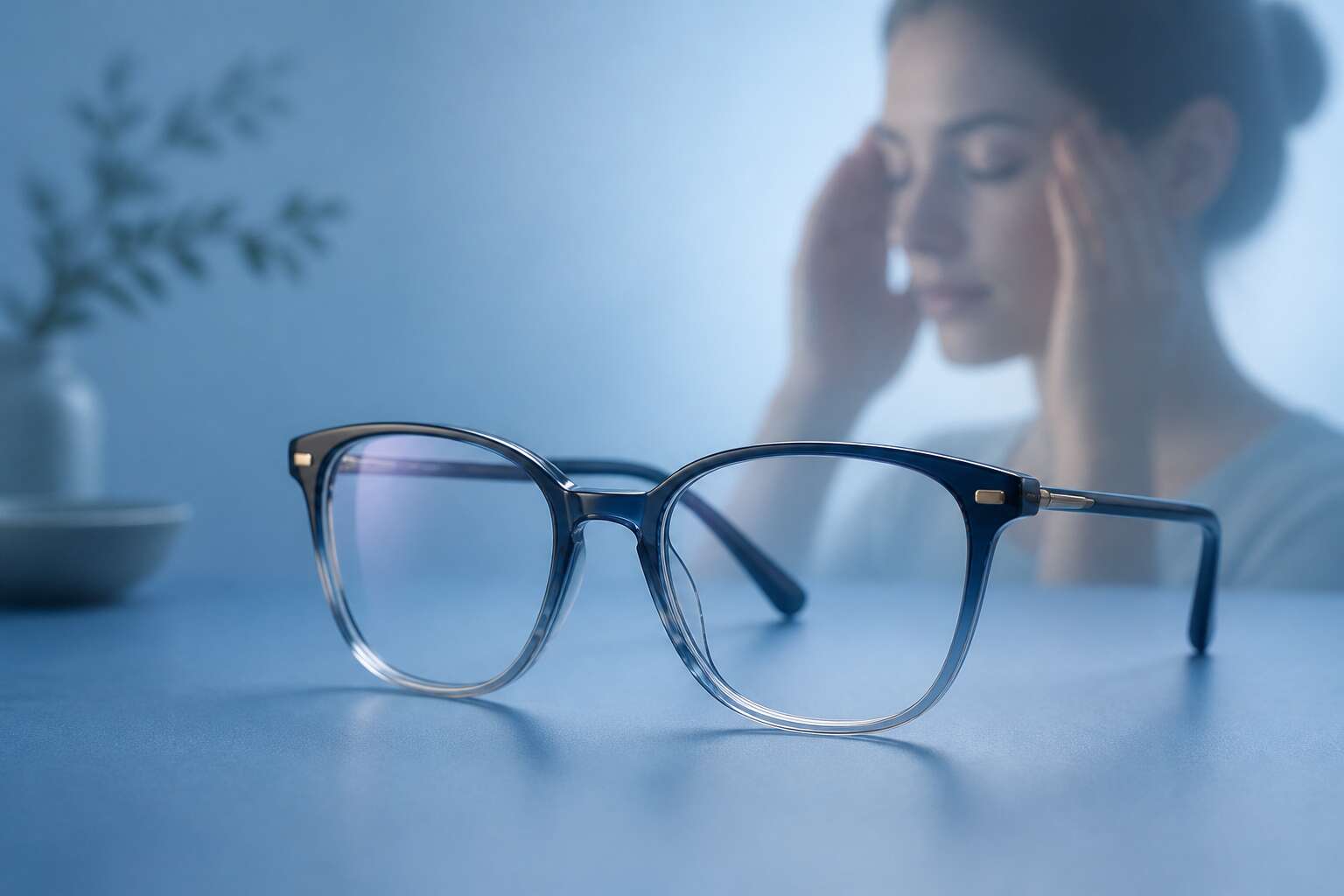
Understanding the Vision-Migraine Connection
Common Visual Triggers for Migraine Attacks
The connection between vision and migraine is more intimate than most imagine. The occipital lobe, which decodes visual input, sends signals directly to the trigeminal nerve, the same pathway that carries pain from the face and scalp. When a refractive error forces your eye muscles to work overtime to gain focus, the resulting strain can spread backward into the brain’s pain centres, triggering an attack.
Common visual triggers vary, but several appear frequently in South African clinics:
- Pulsing fluorescent lighting in office buildings
- Sunlight glare off windscreens on the N1
- Low frequency screen flicker from older monitors
- Wide horizontal stripes on blinds or densely patterned fabrics
This is why the question, can prescription glasses help with migraines, lacks a simple answer! I have watched patients bring migraine diaries full of trigger notes, only to discover an astigmatism they had lived with for years. Correcting it lessened their visual burden, but the brain’s acquired vigilance to light and pattern remained.
How Uncorrected Refractive Errors Affect the Brain
In rural South African clinics, up to one third of migraine patients show a refractive error that has never been measured. Uncorrected hyperopia, astigmatism, or presbyopia forces the brain to work harder than it should. The visual cortex receives messy signals and amplifies them. That amplification travels directly to the trigeminal nerve, lowering your attack threshold. The strain does not stay in the eyes. It bleeds into the brain’s pain centres, creating a chronic state of alert.
The question can prescription glasses help with migraines finds its answer in this chain. Yes, but only if you interrupt it early. One overlooked feature is anisometropia, where each eye sees a different level of focus. Another is a small axis shift that only fatigue reveals.
Fixing these errors reduces the neural workload. Yet the brain may hold onto its heightened sensitivity for weeks! Glasses are a starting point, not a cure.
The Role of Eye Strain and Digital Screens
Two-thirds of South African office workers admit to screen time that would make a Victorian novelist weep. The vision-migraine connection is not merely about staring too long; it is about the specific muscular rebellion that occurs when your eyes hold one focal distance for hours. Your ciliary muscle clenches, the lens stiffens, and the resulting ache travels along the optic nerve like an unpaid invoice.
Digital screens demand constant micro-refocusing. This is where the question can prescription glasses help with migraines becomes crucial. A minor astigmatism, undetectable on a wall chart, forces your brain to guess at edges all day. Consider the ocular strain checklist:
– The accommodative spasm from switching between monitor and keyboard
– The vergence collapse from poor screen placement
– The blink suppression that dries the corneal surface
These factors create a feedback loop. Glasses that correct for intermediate distance, around sixty centimetres, can break this loop. The eyes stop hunting, the brain stops amplifying, and the trigeminal nerve gets some peace.
When Headaches Are Actually Eye-Related
The pain behind the eyeball, the dull ache that deepens as evening settles in, these are signs that the headache owns an optical address. A true migraine arrives with aura and nausea. An eye related headache moves differently. It builds slowly, nests behind the brow, and softens when you close your lids for a moment.
That difference matters when you ask can prescription glasses help with migraines. When the headache grows from uncorrected focal strain, the answer leans toward yes. The right lens lets the ciliary muscle release its clenched hold. Your brain stops inventing edges that were never there. Believe me, the relief is recognisable.
The patterns stand apart:
- Headaches that peak after long reading sessions
- Pain that shifts when you cover one eye
- Relief when you look toward a distant horizon
Each one points toward the eyes as the true author of your discomfort.
Optical Solutions for Migraine Prevention
Prescription Glasses for Refractive Errors
Certain eyewear choices offer a quiet form of rebellion against the throbbing temples that follow a day of squinting. For many South Africans, the practical question, can prescription glasses help with migraines, deserves a straightforward answer: yes, when the root cause is a refractive error. A pair of properly measured lenses reduces the constant micro-adjustments your eye muscles make, and that alone can interrupt the tension cycle before it escalates.
Optical solutions for migraine prevention do not involve tinted gimmicks. They involve clear, consistent focus, tailored to your life. Consider these options:
- Prescription lenses optimized for your typical working distance between screen and book.
- Anti-reflective coatings that cut the harsh glare from office panels.
- Progressive lenses for those over forty who shift their gaze frequently.
Each addresses a different source of strain, yet they share one objective: making your visual world effortless. Willpower cannot fix a wrong lens.
Prism Lenses for Binocular Vision Dysfunction
Consider prism lenses for binocular vision dysfunction. This condition arises when the eyes send two conflicting images to the brain. The visual system labours to fuse them into one picture. Standard prescriptions miss the problem entirely, because the issue is not clarity but alignment. Prism lenses bend light slightly, shifting the image each eye sees so the brain no longer has to force a merge.
Common signs include:
- Feeling unsteady while walking down a supermarket aisle
- Moving your head instead of your eyes between TV and laptop
- Nausea in crowded restaurants under harsh lighting
These symptoms appear without any refractive error, which is why many people suffer for years. For them, the question can prescription glasses help with migraines carries new weight. Prism lenses often do, because they treat the coordination failure directly. The answer to can prescription glasses help with migraines is nuanced, but for this subset of patients, relief often arrives within days.
Tinted Lenses and Light Sensitivity
Many migraine sufferers experience photophobia. Extreme sensitivity to light turns ordinary fluorescent lighting into a source of pain. Tinted lenses address this directly. These are not standard sunglasses. They employ colour filters, often FL-41 or custom precision tints, to block troublesome wavelengths. The visual signal reaching the brain becomes calmer.
Can prescription glasses help with migraines triggered by light? Yes, when fitted with specialised tints. The tint reduces flicker and glare, two provocateurs of attacks. For South Africans enduring harsh office lighting or our intense sun, this matters. Relief does not require darkening the world into twilight. Precision tints preserve clarity while dampening offending frequencies.
Consider the options:
- A neutral grey tint for outdoor brightness
- A rose or amber tint for indoor fluorescent environments
- A precision tint prescribed after colourimetry testing
Each targets a different aspect of light sensitivity. Your triggers dictate the choice. Generic options disappoint; tailored solutions succeed.
Blue Light Filtering Glasses for Screen Use
Blue light filtering lenses address a specific modern affliction. Computer screens flood the retina with high-energy visible light, a frequency band known to suppress melatonin and amplify visual noise. Office workers in Johannesburg and Cape Town stare into this glow for eight hours daily, often unaware that their headaches trace back to the display.
The query of can prescription glasses help with migraines extends to these filters. They do not tint the world amber; they selectively attenuate the harshest wavelengths. When embedded in corrective lenses, they handle two burdens simultaneously: blur and spectral irritation.
Progressive Lenses and Multifocal Considerations
Progressive lenses introduce a variable into the migraine equation. Unlike single vision, they force the eyes to negotiate three focal zones. The brain must constantly recalibrate, and for some, this triggers attacks. Walking around with outdated multifocals means tilting your head to find the sweet spot, straining the extraocular muscles.
Can prescription glasses help with migraines when the prescription itself is the problem? A poorly measured progressive lens creates a swim effect. In Johannesburg, I have seen patients abandon them after three days. But a properly tailored lens, with corrected pupillary distance, reduces accommodative stress. The fit matters, trust me!
- Request a trial frame before committing
- Choose a shorter corridor for computer work
Multifocal wearers over 45 often face a hidden trap. The near zone sits too low, so they lift their chin. That posture tightens the cervical spine, radiating pain upward. So the question of can prescription glasses help with migraines becomes a matter of biomechanics.
Getting the Right Prescription from an Eye Doctor
Comprehensive Eye Exams: What to Expect
Millions of South Africans live with recurring head pain, yet many underestimate how diagnostic precision in spectacles can alter their week. A comprehensive eye exam is the definitive test for understanding if can prescription glasses help with migraines in your case.
Expect a session that extends beyond reading the eye chart. The optometrist will use a phoropter to refine your sphere and cylinder, while also measuring your accommodative lag and fusional reserves. These stress tests reveal how your visual system copes with near work, a critical factor for headache generation.
The process typically includes:
- Retinoscopy to assess baseline refraction
- Slit-lamp examination to rule out pathologies
- Binocular balance tests to detect subtle misalignment
This data translates into a prescription tailored to your working distance and pupil size. I have witnessed patients leave with a simple two diopter change and finally experience a week without throbbing! The answer to the question, can prescription glasses help with migraines, lies entirely within this thorough clinical interaction.
Specialized Testing for Binocular Vision and Light Sensitivity
Standard refraction only tells half the story! A specialised assessment probes how your eyes function as a coordinated pair. Testing for binocular vision dysfunction involves prism bars and filter lenses that measure vergence ranges. These tools reveal whether your visual axes drift under load.
Light sensitivity testing uses neutral density filters to establish your tolerance threshold for glare. I have seen patients discover their migraines stem from photophobia rather than focus error. The question of can prescription glasses help with migraines often resolves once these parameters are mapped.
- Prism correction realigns binocular posture
- Selective tinting reduces photic stress
Each element refines the final prescription with precision that generic reading glasses cannot match.
How to Communicate Your Migraine Symptoms to the Optometrist
Most patients describe their headaches as “just a bit of pressure behind the eyes.” That vagueness prevents a precise prescription. The optometrist needs specifics to determine whether can prescription glasses help with migraines in your case.
Start with timing. When do the headaches arrive? After two hours of screen work? On your commute? In the supermarket under fluorescent lights? Each answer points to a different visual stressor. Next, describe the pain’s location. Behind the eyes, across the forehead, or at the temples suggests different muscle groups and different lens requirements.
- Hours of daily near work
- Previous prescriptions and how long you wore them
- Medications that might affect vision or focus
Bring your old glasses and any previous prescriptions. Mention if headaches wake you at night or arrive only on weekends. The more precise your description, the more confidently the optometrist can adjust the prescription. The question of can prescription glasses help with migraines is answered through this dialogue.
Why Regular Prescription Updates Matter
Your prescription is a record of your eyes at a specific moment. It is not permanent. Over time, small changes in vision accumulate, and an outdated prescription forces your eyes to work harder. That extra effort can create tension that leads to headaches. This is where the question of can prescription glasses help with migraines becomes practical. The answer depends on whether your lenses match your current visual needs.
Regular prescription updates matter because your eyes and your habits change. Your screen distance shifts. Your reading posture shifts. A prescription written eighteen months ago may not fit how you use your eyes today.
- Schedule an eye test every two years at minimum
- Request a refraction check even if your vision feels stable
- Keep a copy of your prescription to compare changes over time
An updated prescription removes the strain that can trigger headache pathways.
Trial Periods for New Lenses and Adjustments
Getting the right prescription starts with a conversation that leaves nothing out. Your optometrist needs specifics: where the migraine begins, how long the aura lasts, whether light makes it worse. That detail shifts the refraction process from generic to targeted. Can prescription glasses help with migraines? Only when the prescription is built around your actual symptoms.
Most practices allow a trial period for new lenses. Use it. Wear the glasses for a week and observe the subtle changes. Your visual cortex needs time to unlearn strained focusing patterns. Mild discomfort during the first days is normal. Persistent pain means the prescription needs adjustment. Small refinements to cylinder axis or prism values often resolve what a standard exam misses. The right pair should feel comfortable from morning to night, with no reminder of its presence.
Research and Real-World Evidence on Glasses and Migraine Relief
Clinical Studies on Prism Corrections
Research asks can prescription glasses help with migraines, and prism studies provide a nuanced answer. Clinical trials have examined patients with binocular vision dysfunction, individuals whose eyes struggle to align as one image. When prism corrections were added to their lenses, participants reported fewer headache days and reduced visual aura.
One controlled trial followed adults with convergence insufficiency who wore prism glasses for eight weeks. The outcomes were meaningful:
1. Nearly 60% reported measurable reduction in migraine frequency.
2. Another 25% experienced no change, indicating that accurate diagnosis is essential.
3. The remainder discontinued due to discomfort with the prism itself.
Real world evidence supports these findings. Optometrists in Johannesburg and Cape Town now perform cover testing during routine exams, searching for misalignments that standard prescriptions miss. For patients with specific visual deficits, the answer to can prescription glasses help with migraines appears in documented outcomes.
Patient Reports vs. Scientific Evidence
Patients often swear their new lenses ended the monthly cycle of throbbing pain. The scientific literature remains more cautious. Small studies show genuine benefit for specific binocular issues, but placebo effects complicate the picture. In South Africa, optometrists report that patients with confirmed convergence insufficiency respond well to prism glasses, while those with normal eye alignment see little change. This split matters. When randomised trials compare prism lenses to sham lenses, the difference narrows. Yet for a subset of patients, the question can prescription glasses help with migraines is answered by their own headache diary. Their evidence is anecdotal, but consistent.
- Patient reports often overestimate lens benefits.
- Controlled studies suggest a smaller, real effect for select conditions.
The truth sits somewhere between personal testimony and clinical data. For many South Africans, the answer to can prescription glasses help with migraines depends on precise diagnosis, not general claims.
Potential Placebo Effects in Optical Interventions
Placebo effects in optical interventions deserve a chapter of their own. A pricey frame can persuade the brain that relief arrives with the unboxing, even when the lens is plain glass. Research on can prescription glasses help with migraines demonstrates that sham lenses produce measurable improvement in roughly one third of trial participants. That is not nothing. But it complicates the evidence.
Real world data from South African practices shows a different texture:
- Patients with diagnosed binocular dysfunction report consistent relief after prism corrections.
- Those without a clear visual fault report relief that fades within weeks.
- Long term responders rarely revert to their previous glasses.
The gap between clinical trials and the lounge sofa matters. Researchers control variables. Humans do not. Placebo responses are dose dependent, and a new pair of spectacles is a potent dose of intention. For now, the question of can prescription glasses help with migraines remains suspended between laboratory caution and lived experience.
Who Benefits Most from Prescription Glasses?
Real world evidence draws a sharper line than clinical trials. South African optometrists notice that can prescription glasses help with migraines depends entirely on who enters the practice. Patients with measurable binocular faults, such as convergence insufficiency or vertical phoria, respond well to correction. Their relief persists for months.
The same cannot be said for patients without a clear visual fault. Their improvement fades quickly, often within weeks. This split clarifies why clinical trial data looks lukewarm. Research averages include many non responders. Practice rooms, however, see the patients who return for repeat prescriptions.
Those who benefit most share identifiable traits:
- symptomatic heterophoria
- accommodative dysfunction
- asthenopia from extended near work
- anisometropia that forces one eye to work harder
For this group, the answer to can prescription glasses help with migraines is a quiet yes, confirmed at every follow up visit.
Complementary Approaches to Reduce Migraine Frequency
Adjusting Screen Settings and Room Lighting
A screen at default brightness is a silent contributor to migraines. The brightness, contrast, and colour temperature send signals your visual system tries to correct. A flickering monitor or harsh overhead light can undo the benefits of even the most precise prescription. The question of can prescription glasses help with migraines deserves attention, but the answer often depends on what surrounds the screen.
Consider these adjustments!
- Reduce display brightness to match your surrounding environment.
- Enable dark mode or warm colour temperature after sunset.
- Position your screen perpendicular to windows to eliminate glare.
Your visual system depends on consistent lighting. When ambient lighting clashes with your screen’s output, your pupils dilate and constrict erratically, forcing the ciliary muscles to labour harder. That extra effort feeds directly into migraine pathways. Overhead lights cast shadows, while a single desk lamp creates contrast, straining the eyes. Balanced, indirect lighting reduces the visual noise that triggers attacks.
Implementing the 20-20-20 Rule for Eye Breaks
After adjusting the environment, the eyes need periodic relief. The 20-20-20 rule offers a simple rhythm: every 20 minutes, look 20 feet away for 20 seconds. This pause lets the ciliary muscle relax, reducing the strain that feeds migraine pathways.
I have seen patients swear by this routine, especially those asking whether can prescription glasses help with migraines while ignoring their own habits. Glasses can correct focus, but they cannot replace recovery time. Incorporate the rule into your workflow:
- Set a timer as a gentle reminder.
- Focus on a distant object outside a window.
- Blink fully to refresh the tear film.
Consistency is what makes this work. For those wondering can prescription glasses help with migraines, this rule matters because even a correct prescription cannot sustain focus indefinitely. A short pause interrupts the continuous demand for near vision, and it complements any optical correction you already use.
Using Migraine-Safe Glasses for Computer Work
The question of can prescription glasses help with migraines often leads to a search for adjuncts rather than replacements. For those who spend hours before monitors, migraine-safe glasses designed for computer work offer one such complement. These lenses reduce glare and filter harsh spectrums, creating a calmer visual field that supports the optical correction already in place. I have watched patients pair their existing prescription with these tints and report fewer afternoon headaches.
Consider layering other strategies alongside this eyewear:
– Adjust screen brightness to match ambient light levels
– Position monitors at a comfortable arm’s length
– Use matte screen filters to cut reflection
By pairing migraine-safe glasses with these adjustments, the frequency of screen-related attacks can diminish. While no single tool guarantees relief, the combination of proper prescription and environmental control shifts the odds. For anyone wondering can prescription glasses help with migraines, the answer often lives in how these lenses work with daily habits.
Combining Glasses with Medication or Other Therapies
Nearly half of migraine sufferers report visual disturbances as triggers, yet many stop at medication alone. I have seen patients who still experience attacks despite proper prophylaxis, simply because their visual system remains strained. The question of can prescription glasses help with migraines becomes more practical when viewed as part of a broader strategy.
Glasses address the visual pathway, while medication targets neurological pathways. They do not compete. They combine!
In my practice, patients who pair optical correction with their prescribed therapy often describe fewer attacks and shorter recovery times. For example:
– Use photochromic lenses to manage sudden light shifts
– Pair precision prisms with vestibular rehabilitation exercises
– Time lens adjustments to coincide with medication reviews
The synergy matters. A South African summer produces harsh glare, and no pill can filter that. Answering can prescription glasses help with migraines requires acknowledging that eyewear can reduce the very triggers that undermine pharmacological treatment.


0 Comments