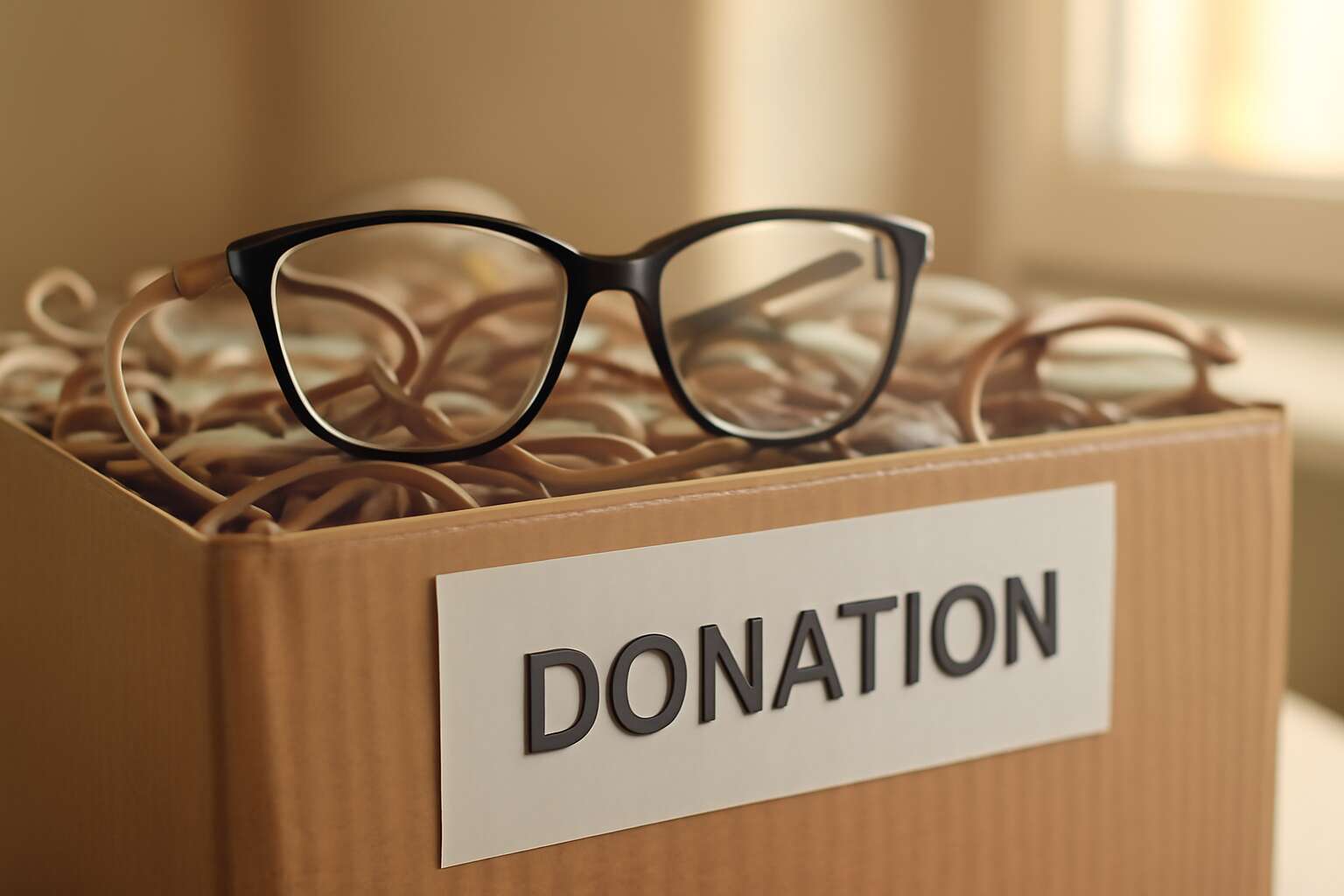
The impact of donating prescription glasses
Who can donate and how to verify eligibility
Globally, 2.2 billion people live with vision impairment, and over 1 billion could be corrected with glasses. In South Africa, underserved communities feel that gap in classrooms and clinics. I often hear the question: can prescription glasses be donated? The answer is yes, and the impact is quietly transformative.
Donors range from families to schools and small clinics. In my experience, a single pair can sharpen a child’s sight in class and empower an adult at work. When sight clears, potential follows.
How to verify eligibility, quickly:
- Prescription readable and frames intact
- Not sunglasses or novelty frames
- Check acceptance and cleaning guidelines with the partner
What items count as prescription eyewear
In the soft hush of a classroom, a single pair of glasses can rewrite a day. Globally, 2.2 billion people live with vision impairment, and many could be corrected with a simple gift. “can prescription glasses be donated”? Yes—and the impact is quietly transformative. In South Africa, underserved communities feel the gap in classrooms and clinics; a child sees the board clearly and a worker returns to focus with renewed poise.
What items count as prescription eyewear? The essentials include:
- Frames with prescription lenses in good condition
- Reading glasses with a valid prescription
- Bifocals or progressive lenses
Beyond the frame and lens, the ripple extends into families, schools, and clinics—opening a world of readability, independence, and dignity. When sight clears, potential follows.
Geographic availability and pick-up options
Every donated pair carries a ripple of change. In South Africa, a child moves from squinting at the board to reading with ease; a nurse regains focus at the ward and steadies a patient’s hand. Globally, 2.2 billion people live with vision impairment, many of whom could be helped by a simple gift. can prescription glasses be donated? Yes—its impact is quiet, potent, and immediate.
Geographic availability and pick-up options make donating practical. In South Africa, drives reach urban hubs, townships, and rural clinics through partner optometrists and mobile units. If you’re wondering where your glasses can go in your community and how they’re collected, here are the kinds of paths you’ll encounter:
- Urban hubs and township clinics connected with eye-care partners
- Rural outreach via mobile vision units
- School-based donation events during term times
- Community centers and NGO partner sites as collection points
How donations address vision disparities
One donated pair becomes a doorway to opportunity, a hinge where learning swings open. The question lingers: can prescription glasses be donated? The answer rings clear: yes, and the impact is quiet, immediate, and enduring in South Africa’s classrooms, clinics, and community hubs.
Donated glasses shrink disparities by restoring clarity where it matters most: classrooms, clinics, and small workplaces.
- Improved literacy and focus in classrooms
- Safer, sharper patient care in clinics
- New possibilities for work and daily life
Each frame travels forward, carrying stories and possibilities, a shared gift that keeps renewing community life. I’ve seen how clear sight can lift a student’s voice and steady a nurse’s hands, turning a moment of vision into a day of progress.
How to prepare and package donation eyewear
Cleaning and sanitizing glasses before donation
Clear sight is a passport to opportunity in South Africa, and every donation has the power to sharpen someone’s day. can prescription glasses be donated? Yes—when care guides the process, from curbside drop-off to the moment a recipient tries them on. A local optometrist reminds us that “Clean glasses are a passport to daily life,” and that ethos permeates our handling of each pair.
Before packing, consider these broad facets to keep glasses ready for use:
- Basic hygiene and surface care
- Sanitization considerations
- Packaging and handling standards
- Record-keeping and transparency
With quiet attention to these elements, donated eyewear travels toward brighter futures while preserving dignity and function.
Removing lenses or frames: when to do it
Every donated pair opens a passport to unseen paths and brighter days; can prescription glasses be donated, you ask, as care guides the journey. The answer travels on a careful current: frames and lenses are treated as a unified gift, unless guardians of policy advise a gentle separation.
Removing lenses or frames is not a casual whim but a measured pause—done only when it preserves clarity or aligns with program standards. In that moment, the pieces rest apart, a quiet breath between care and transit, safeguarding every detail of vision.
Pack with reverence and a light touch, letting the journey begin in South Africa’s communities where dignity travels with every well-kept frame.
Packaging guidelines and labeling
One well-packed box can light up a classroom and brighten a life! ‘can prescription glasses be donated’—the question guiding every careful handoff? Yes, when preparation stays deliberate.
Prepare each pair as a single, thoughtful gift: keep intact frames, avoid cracks, and nestle them in a soft microfiber pouch inside a sturdy outer packet. Use sealable bags to deter dust, and choose cartons that weather South Africa’s transport routes.
- Wrap each pair in a soft pouch to prevent scratches
- Place the pouch in a sealable inner bag inside a sturdy carton
- Include a packing note with destination program and packing date
Labeling should be clear and durable—avoid fading handwriting. Attach a label listing the item count, basic prescription type (single-vision or multifocal), and the packing date. If privacy allows, add a contact point for the receiving clinic.
Documentation and receipts for tax purposes
Across South Africa, vision gaps affect millions of learners daily, turning bright futures into blurred streets. When people wonder can prescription glasses be donated, the answer glows yes—provided every gift travels with precise records that honor both donor and recipient.
Documentation for tax purposes keeps this generosity shining.
- A donor receipt suitable for tax claims is issued.
- There is an item count, basic prescription type (single-vision or multifocal), and the condition of each pair documented.
- Destination program and donation date are recorded.
- Copies are retained for records and a simple acknowledgment from the receiving clinic is obtained.
Keep digital backups and secure archives, as formal donation forms and clinic confirmations strengthen transparency under South Africa’s tax framework, ensuring that every donated pair remains a well-documented gift that lights up classrooms.
Where to donate prescription glasses
Partner organizations and programs
“A single pair of glasses can change a life,” and I’ve seen that truth ripple through South Africa. The question ‘can prescription glasses be donated’ lies in a network of partners who transform old lenses into new opportunities for sight. I’ve watched classrooms brighten when someone can finally read the board.
Where to donate and who runs the programs matters. For those asking ‘can prescription glasses be donated’ in South Africa, trusted partners connect donors with recipients. Partner organizations and programs include:
- Lions Clubs International – Recycle for Sight
- VisionSpring outreach partners
- Optometry Giving Sight collaborations
Local clinics and NGOs can guide you on drop-off points, ensuring your donation travels to someone who needs it most.
Drop-off vs. mail-in options
A single pair can unlock a classroom’s horizon, and in South Africa that payoff travels far through a quiet, dependable network. When you ask can prescription glasses be donated, the answer is a warm yes—through trusted partners that channel eyewear to people who need it most.
Where to donate prescription glasses? Drop-off points are often overlooked, but they are abundant in community spaces. Drop-off vs. mail-in options come into play; drop-off is fastest when a site is nearby, while mail-in can reach distant communities. For convenience, consider these common hubs:
- Local clinics and pharmacies with donation bins
- Lions Clubs International – Recycle for Sight collection points
- VisionSpring outreach sites and Optometry Giving Sight collaborations
For those outside fixed drop-offs, mail-in programs offer a bridge. Reach out to a local partner to receive a prepaid label and clear instructions—this keeps the process straightforward and accountable.
Regional collection drives and events
In South Africa, a single donated pair can brighten a classroom more than a whiteboard ever could. Regional collection drives and events pop up in clinics, libraries, and community hubs, turning generosity into real access. When you ask can prescription glasses be donated, the answer is a warm yes—through trusted partners that channel eyewear to people who need it most.
Where regional drives take place, and what to look for:
- Municipal markets and charity runs
- University and school eyewear drives
- Faith-based community centers hosting eyewear fairs
These drives illustrate a network built on generosity, widening sight lines across communities without fuss or fanfare.
Finding a local donation center
Across townships, clinics, and libraries, a single donated pair can light a path toward clearer days. can prescription glasses be donated? Yes—through trusted partners who channel eyewear to those who need it most, turning simple generosity into genuine access.
- Local clinics and optometry practices
- Public libraries and university campuses
- Community centers and faith-based organizations
Seek out partner programs in your area; many drive donation centers into everyday spaces, making it easy to participate!
What happens after you donate
Sorting, inspecting, and repairing glasses
Once a donor’s parcel lands at a collection hub, the real work begins: sorting by frame condition, prescription compatibility, and repair potential. Staff inspect lenses for scratches, delamination, and edge wear, then decide whether a frame can be resurrected or should head for recycling. Minor fixes—tightening screws, swapping nose pads, a quick alignment—happen on the bench, while stubborn issues are sent to specialists.
Through careful processing, the team ensures only usable eyewear continues its journey. can prescription glasses be donated is answered by the workflow that follows:
- Sorting by usability and prescription range
- Inspecting for safety and structural integrity
- Repairing or rerouting to recycling when necessary
After checks, glasses are cleaned, repackaged, and shipped to partner clinics or distribution hubs across South Africa, where a new owner might finally discover the world beyond fogged glass and distant excuses.
Who benefits from donated eyewear
After you donate, can prescription glasses be donated? The journey continues through a network of clinics and distribution hubs in South Africa where usable frames are matched to wearers, sanitized, and prepared for travel. Glasses are cleaned, repackaged, and shipped to partner clinics or distribution hubs across South Africa, where a new owner might finally discover the world beyond fogged glass and distant excuses.
- Students in under-resourced schools
- Patients in rural clinics and urban outreach programs
- Families who cannot afford new eyewear
The impact is practical and personal, translating into steadier study days, safer work, and brighter mornings. Each donation narrows gaps in access to vision, turning small acts into lasting change.
Impact metrics and donor reporting
After you donate, the journey continues through a network of clinics and distribution hubs across South Africa. Each pair is logged, sanitized, and matched to a wearer, and impact is tracked in real time. The question: can prescription glasses be donated? The answer is yes—through approved programs that ensure safety, traceability, and dignity for every recipient. Donor data flows into transparent impact dashboards, letting you see where your glasses travel and who benefits.
- Number of wearers supported by partner clinics
- Geographic reach across rural and urban communities
- Outcomes and feedback from recipients, including education and safety improvements
That reporting empowers donors with clarity and continuity, reinforcing the value of each act. The result is measurable progress—steadier study days, safer work, brighter mornings!
Common challenges and how programs handle them
Eyes are the window to the day, and in South Africa, every donation can brighten more than one morning. can prescription glasses be donated? Absolutely—after you drop them off, they enter a nationwide loop of clinics and hubs where care, safety, and dignity steer the process. Each pair is logged, sanitized, and matched to a wearer, with progress visible on transparent dashboards that show where your glasses travel and who benefits.
Common challenges pop up, but programs pivot with practical solutions. From scattered inventory to fragile frames, the system is designed for resilience.
- Inventory imbalances across rural and urban areas, mitigated by centralized pooling and smart redistribution
- Frames or lenses requiring repair or replacement, handled by in-house or partner technicians
- Transit delays or logistics hiccups, addressed with reliable couriers and contingency routing
Donors still get transparency through dashboards, knowing their act translates into safer mornings and brighter futures.


0 Comments