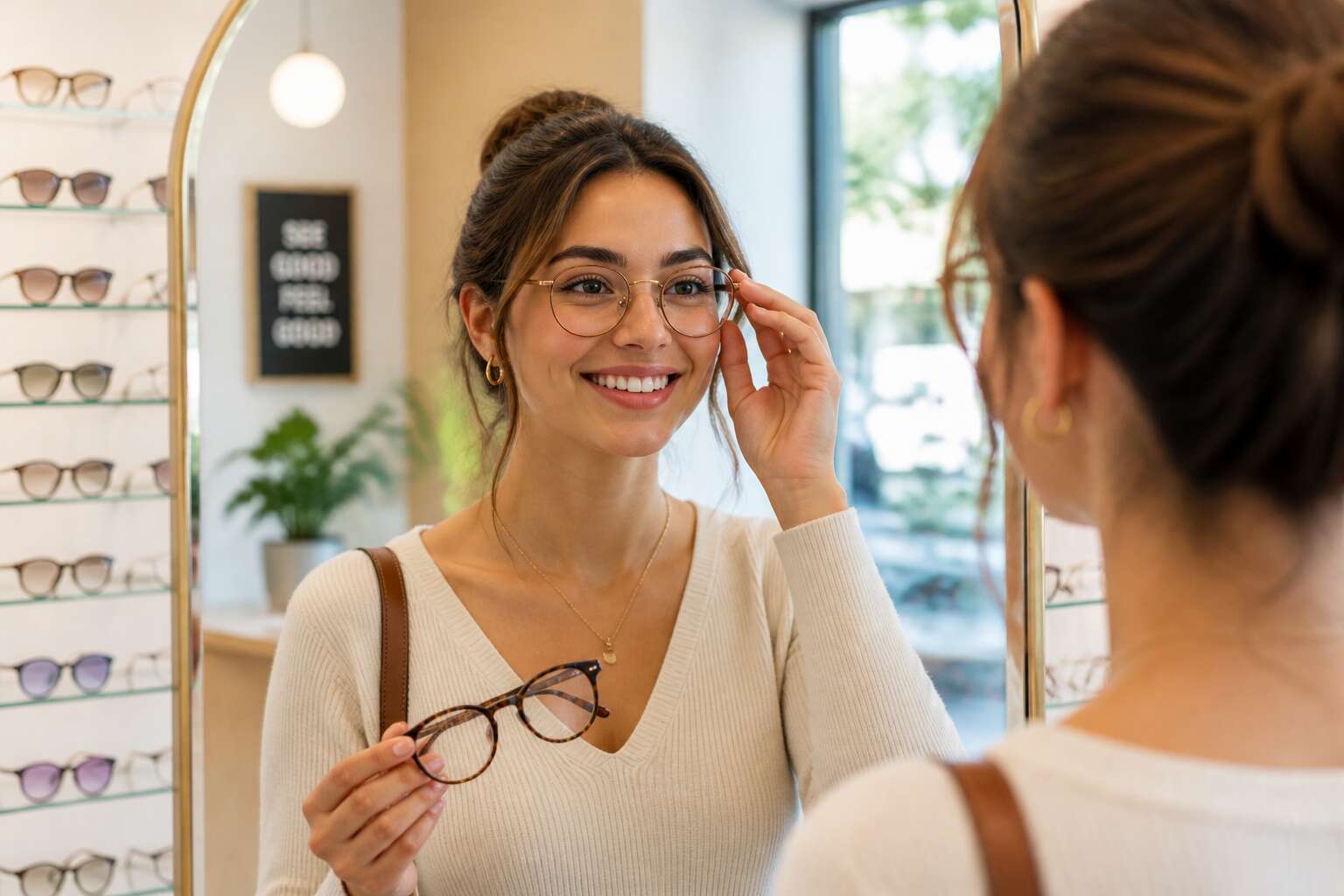
Virtual Try-On Technology Explained
How AR and AI Simulate Frame Fit
Virtual try on has moved past simple photo filters. Augmented reality maps your facial geometry in real time, while artificial intelligence evaluates critical measurements such as pupillary distance and cheekbone angle. Together, these technologies place a digital frame onto your face with accuracy, showing proportions, shadow, and perspective.
When you begin a prescription glasses try on, the system captures hundreds of facial data points. It adjusts the frame’s position to match your nose bridge width, temple length, and even ear height. This produces a realistic preview that helps you decide without visiting a physical store.
- AR overlays the chosen frame onto your live image.
- AI computes frame curvature and fit over time.
- You can view the fit from multiple angles before ordering.
Camera-Based Measurements and PD Estimation
Your camera becomes a measuring instrument. It detects your pupils and calculates pupillary distance with millimetre precision. That number determines where your optical centres sit. Get it wrong, and a perfect frame feels off. For a prescription glasses try on, this measurement matters most. I have seen people ignore PD and end up with headaches. The camera also estimates vertex distance and pantoscopic tilt, both critical for high prescriptions. Here is what it captures in seconds:
- Pupillary distance for each eye
- Distance from lens to cornea
- Brow and cheekbone angle
Each data point feeds the fit algorithm. The result is a try on that respects your anatomy, not a generic model.
Texture, Color, and Lens Simulation Accuracy
One in three people abandon a virtual frame within seconds because the screen lies. The LCD shows colour and texture, but it cannot show how a lens bends light. This is where the lens solver takes over. It simulates the optical properties of your prescription, not just the frame. Every flint glass element, every anti-reflective coat, gets recreated in the renderer. The result is a preview that matches the physical product with disturbing accuracy.
The application captures four photometric properties during the scan.
– Transmission curves for the exact lens material, like 1.67 or Trivex
– Subsurface scattering values in the acetate
– Diffuse and specular reflection on the frame’s surface
– Chromatic aberration at the lens edge
These numbers feed a physically based rendering engine. The light in your browser behaves like light in a store. The thickness at the edge shows true for a high minus prescription. The distortion you see at the edges is the real distortion, calculated from your axis and cylinder. This gives you a prescription glasses try on that shows what you will actually get, not a stylised fantasy.
Finally, the simulation renders accommodative blur. It shifts the focal plane based on your reading distance. You see the world, and the frame, the way your corrected eye would. That is the difference between a pretty picture and an informed purchase. This visual honesty reduces returns and builds trust before you pay.
Ways to Try Before You Buy
Home Try-On Kits vs Digital Tools
The home try-on kit arrives with five frames nestled in felt, each one a tangible promise. You wear them while stirring a pot of bobotie, or during a sunset drive along Chapman’s Peak. The physical weight, the hinge resistance, the way they settle on your nose. No screen can replicate that.
Digital tools summon a different enchantment. A selfie uploaded, and frames materialise on your face within seconds. For readers in Durban or Pretoria, far from the nearest optical boutique, this immediacy holds real value. Yet these tools demand honest lighting and a steady hand.
Here is the essence of the prescription glasses try on journey: home kits reveal how frames feel, digital tools reveal how they look. The prescription glasses try on experience becomes complete only when both perspectives are honoured, the tactile and the virtual intertwined.
Using an App to Preview Frames
Open the app on a Tuesday afternoon. The camera locks onto your pupils, measuring the distance between them with care. For a reliable prescription glasses try on, use a window for light and keep your phone steady! The app renders frames in real time, letting you turn your head, narrow your eyes, or laugh at a message.
To improve the preview quality:
- Choose a plain wall behind you.
- Adjust the frame height until it aligns with your pupils.
- Save your favourite styles for side by side comparison.
Some apps record a short video of you wearing each frame. This recording sharpens your prescription glasses try on at home. It becomes your honest advisor, revealing how the glasses sit during a nod or a shrug. In Johannesburg or Cape Town, this tool turns a phone into a fitting room.
Visiting an Optical Store for a Fitting
Seventy percent of frame returns stem from poor fit, not style. That statistic explains why visiting an optical store for a fitting still matters. A physical frame reveals pressure points, weight distribution, and slip tendencies that no screen can simulate. The optician adjusts nose pads and temple arms while you feel the result immediately. This real time feedback makes a prescription glasses try on more visceral than any digital preview.
When you stand before the mirror, evaluate three things:
– Does the frame stay level when you tilt your head?
– Are the temples hugging without digging?
– Does the lens plane sit close enough to your eyes?
These observations ground your decision. After weeks of using apps and home kits, your own body becomes the final judge. For clarity and comfort, the optical store fitting remains irreplaceable. It completes the prescription glasses try on journey with honesty.
Sending Photos for Stylist Recommendations
A stylist sees in ten seconds what you notice after ten minutes. Sending images to a stylist turns the prescription glasses try on into a consultation. The stylist examines bone structure, skin undertone, and pupil distance. They observe posture and silhouette. This method relies on human eye, not software.
To get useful feedback, you must provide clarity. Capture:
- a front facing shot with neutral expression
- a profile view to reveal temple lines
- a three quarter angle for lens depth
Use natural light, no filters. The stylist reads the geometry of your face and recommends frames that fit your actual habits. A photograph cannot simulate weight or pressure. It offers a second opinion.
I have found a curated recommendation reveals choices I would have missed. The prescription glasses try on becomes a dialogue of observation. Honesty surfaces when a stylist sees what you overlook.
Leveraging Social Media Filters for Frame Style
Social media filters turn your face into a testing ground. They let you try frames through a screen that flatters and distorts in equal measure. I have seen people believe a style fits when it does not. The filter softens edges, adjusts light, and creates a version of you that may not exist. Yet the prescription glasses try on becomes playful. Compare round versus square, thick versus thin, without commitment. Treat filters as inspiration, not a mirror.
Some platforms save side by side comparisons. That helps narrow preferences before visiting an optical store. But a filter tends to slim the face and sharpen jawlines. That changes how frames land.
Consider this:
- Check if frames touch your eyebrows in real life versus on screen
- Notice how the filter handles reflection
- Use multiple angles
The digital version offers limited truth.
Matching Frames to Your Face Shape
Determining Your Face Shape
Most people can identify their skin type but not their face shape. That becomes a problem during a prescription glasses try on, because frame geometry either balances or fights your natural contours.
Pull your hair back and look straight into a mirror. Trace your jawline, cheekbones, and forehead with a washable marker. The outline reveals one of five categories: oval, round, square, heart, or diamond.
Each shape pairs best with a distinct style:
- Oval faces suit geometric frames.
- Round faces benefit from angular shapes.
- Square faces soften with curved lenses.
- Heart faces balance with bottom-heavy frames.
- Diamond faces work with cat-eye designs.
Measure the widest points across your forehead, cheeks, and jaw. Compare those numbers to frame dimensions on product pages. The right match shortens your search and makes the entire process feel less like guesswork.
Best Frame Styles for Round and Oval Faces
Most people choose frames that look good on a shelf, not on their own face. That is why the prescription glasses try on experience matters more than the latest trend. Round faces, for instance, need sharp contrast. Angular rectangles carve out definition where softness dominates. Oval faces have more freedom, but geometric shapes with strong brow lines work best to preserve natural balance.
Here is a quick reference:
- Round faces: rectangular or square frames with sharp corners
- Oval faces: geometric frames or bold brow-line silhouettes
- Avoid frames that mirror your face curvature too closely
The bridge width changes everything. A narrow bridge makes the eyes appear wider; a wide bridge shortens the nose. During any prescription glasses try on, check how the temple arms sit. They should rest straight and snug, never pinching or sliding down.
Fit is the difference between a frame you wear and a frame you fight.
Geometric Frames for Square and Heart-Shaped Faces
A square jaw is a statement, and your prescription glasses try on should never fight it. Square faces need geometric frames that soften angles without surrendering to roundness. Squircle frames, which blend square edges with gentle arcs, achieve this. Hexagons also work, because their multiple angles disrupt the boxy symmetry.
For heart shaped faces,the proportions invert. Trapezoidsand bottom weighted rectangles draw attention downward, mitigating forehead width. The upper frame line determines whether the face looks balanced or offset. The frame you choose must respect your own geometry, not the shelf’s.
Using Try-On Tools to Verify Proportions
Proportions are the arithmetic of a good fit. The distance between your pupils and the top of the frame should equal roughly the width of your brow. That ratio, not the mirror’s opinion, tells the truth. A digital try-on tool lets you measure this distance in real time, without a tape measure.
One thing I check every time:
- The frame’s outer edge aligns with your temple line.
- The lens height falls between brow and nostril.
- The bridge sits flush without pinching.
These markers matter more than the style name on the tag. When you use a prescription glasses try on to verify proportion, the face shape conversation becomes a practical checklist. You compare the frame geometry against your facial landmarks, and the tool provides a second opinion you can trust.
Checking Lens Prescription Compatibility
High-Index Lenses and Frame Thickness
When you check a frame’s dimensions during a prescription glasses try on, the lens material rarely crosses your mind. That is a mistake. A strong prescription beyond +4.00 or -4.00 diopters will produce thick edges in standard CR-39 lenses. High-index lenses bend light more efficiently, so they require less material. The result is a slimmer profile, but only if the frame cooperates.
Consider the frame’s lens shape and size. A small, round frame minimizes edge thickness better than a large rectangular one, regardless of index. For rimless or semi-rimless styles, high-index lenses are almost mandatory, since edges remain visible.
- Check the frame’s lens width and height against your prescription.
- Verify the frame’s groove can hold the lens edge thickness.
During a prescription glasses try on, an optician can demonstrate edge thickness simulations for different lens materials. That comparison often determines whether the frame stays or goes.
Progressive Lens Fitting Virtual Considerations
Every prescription glasses try on eventually confronts the truth about progressive lenses. These multifocal designs require a fitting height measured to the millimetre, yet most virtual simulations estimate it. The frame might look charming on your screen, but the lens corridor must align with your gaze.
Consider what a digital fitting cannot verify:
- How the frame’s wrap angle affects peripheral vision
- Whether the segment height matches your natural posture
- The exact vertex distance between your cornea and the lens
During a prescription glasses try on, an optician can adjust these parameters with physical tools. Online previews, however, offer only a visual approximation. That does not make them useless. They help you shortlist candidates. For progressive wearers in South Africa, the bright light also influences lens tinting choices, which no screen can properly simulate.
PD and Pupil Height in Digital Try-On
Here is where your prescription glasses try on hits a snag. Your PD and pupil height are not just numbers. They are the coordinates of your eyes in physical space. A digital tool can guess them from a selfie, but it cannot know how your frame sits on your nose after an hour of wear. The axis of your astigmatism correction shifts if the frame tilts two degrees. That is the difference between crisp vision and a headache.
- The distance between your pupils in pixels
- The position of your pupils relative to a frame outline
- Nothing about your facial asymmetry
Your left eye might sit a millimetre higher than your right. Most humans have that quirk. A virtual simulation flattens it into symmetry. For a simple prescription, this is fine. A complex prescription glasses try on demands pupillometer readings, not pixel estimates. The optician with a ruler and a marker remains the final authority.
Astigmatism and Frame Selection
Astigmatism is where the prescription glasses try on illusion collapses. A cylindrical correction has an axis, and that axis only works if the frame sits perfectly level. A stylish frame that tilts or warps under the weight of thick lenses turns a precise prescription into a blurry mess.
Frame selection for astigmatism means checking lens thickness, curvature, and edge thickness. High wrap frames alter the effective cylinder power. Digital tools often ignore this.
- Ask about base curve compatibility.
- Verify the frame can accommodate your cylinder axis.
- Confirm lens material options before ordering.
A virtual preview shows silhouettes, not optics. The real test remains a physical fitting.
Prism Correction and Frame Fit
Nearly a third of all prescription glasses fail to deliver their full corrective potential, not because the lenses are wrong, but because the frame betrays the math. Prism correction is the silent culprit. Unlike simple sphere or cylinder powers, prism shifts the entire image location. A few millimetres of frame misalignment can undo the binocular alignment your optometrist carefully calculated. This is where the prescription glasses try on illusion becomes genuinely dangerous. Virtual filters show you a face, not the optical geometry.
Frame fit for prism lenses demands precision beyond aesthetics. The optical centre must sit directly over your pupil. Any vertical or horizontal decentration introduces unwanted prism, causing eye strain, headaches, or double vision. Digital tools measuring pupillary distance are helpful, but they cannot assess how a frame sits on your actual nose bridge.
– Verify the frame’s vertical adjustment range before purchasing.
– Confirm lens decentration is possible within the frame’s dimensions.
– Ask about the frame’s tilt and wrap angle, they alter prism orientation.
A virtual preview cannot replicate the weight distribution of a prism lens. The physical fitting, with a real frame on your face, remains the only way to confirm your prescription glasses try on will actually work.
Understanding Lens Width and Bridge Size
Lens width and bridge size are measurement values, not style preferences. They determine whether your prescription can physically exist inside the frame. A high minus lens has thick edges, and a narrow frame can conceal that thickness. A wide bridge shifts the optical centre away from your pupil, especially if your PD is small. A prescription glasses try on cannot show this. The digital render places the frame on your face, but it will not reveal that the lens edge will extend past the frame boundary.
- Compare the frame’s lens width to your previous pair’s measurement.
- Check the bridge size against your nasal width.
- Ask for the frame’s maximum lens thickness tolerance.
When you shop for new eyewear, the numbers on the temple arm matter more than the colour. A frame that clamps or slides changes the vertex distance, which alters effective power. Your prescription glasses try on may appear flawless on screen, yet the physical fit demands geometry that no filter can replicate.
Avoiding Errors When Ordering Online
Watching for Reflections and Lighting
When you attempt a prescription glasses try on, the lighting in your room can affect the entire process. Harsh overhead bulbs cast shadows across your face; soft window light gives a more accurate view. Reflections from screens, mirrors, or glossy walls often obscure the frame details you need to judge.
To capture an accurate preview, stand facing a neutral, matte background. Turn off overhead fixtures and rely on diffused daylight. If your phone camera shows flare or glare, reposition until the lens surfaces settle into clarity.
Common culprits include:
- Backlit windows behind your head
- Polished tabletops bouncing light upward
- Bright white shirts reflecting onto the lower frame
Each distorts how the frames read, making a proper prescription glasses try on feel like guesswork. A quick setup adjustment takes minutes, yet it spares you from ordering a pair that looked perfect in poor light but feels wrong in reality.
Comparing Multiple Angles
When ordering online, a single photograph cannot capture the full story. A proper prescription glasses try on demands that you compare multiple angles, especially if your face has uneven contours or a prominent brow. Front-facing images confirm the bridge width, but they conceal the temple’s curve and lens tilt. Side profiles reveal how the arms angle behind your ears, while three-quarter views expose the frame’s depth against your cheekbones. Top-down perspectives show where the lens sits relative to your eyes.
Each angle answers a different question. Without rotating the virtual model, you risk approving a frame that looks commanding in the mirror yet slides down your nose when you bend over. It is a quiet error, one that repeats with every glance.
- Front view for symmetry and bridge alignment
- Side profile for temple length and lens curvature
- Three-quarter view for frame depth on your face
- Top-down view for lens thickness shifts
Devote two minutes to this multi-angle ritual. Your future self, adjusting those frames later, will understand why the effort matters.
Understanding Return Policies for Glasses
Ordering glasses online without a physical frame is a leap of faith. The prescription glasses try on process reduces surprises, but errors still happen when you ignore return policies. Before you click buy, read the fine print with the same care you give your PD measurement.
Return windows vary widely. Some South African retailers give 30 days, others offer 90. Restocking fees can eat your refund. A list helps you ask the right questions:
- How many days do I have to return?
- Who pays return shipping?
- Are lenses included in the exchange?
- Is there a restocking fee?
Understanding these terms protects you. A generous policy does not excuse a poor fit. When you finally hold your new frames, the time spent verifying the return process feels as valuable as the prescription glasses try on itself. This clarity turns a risky online order into a manageable transaction.


0 Comments