Decoding the Numbers on Your Frame
What Does 57mm Actually Represent?
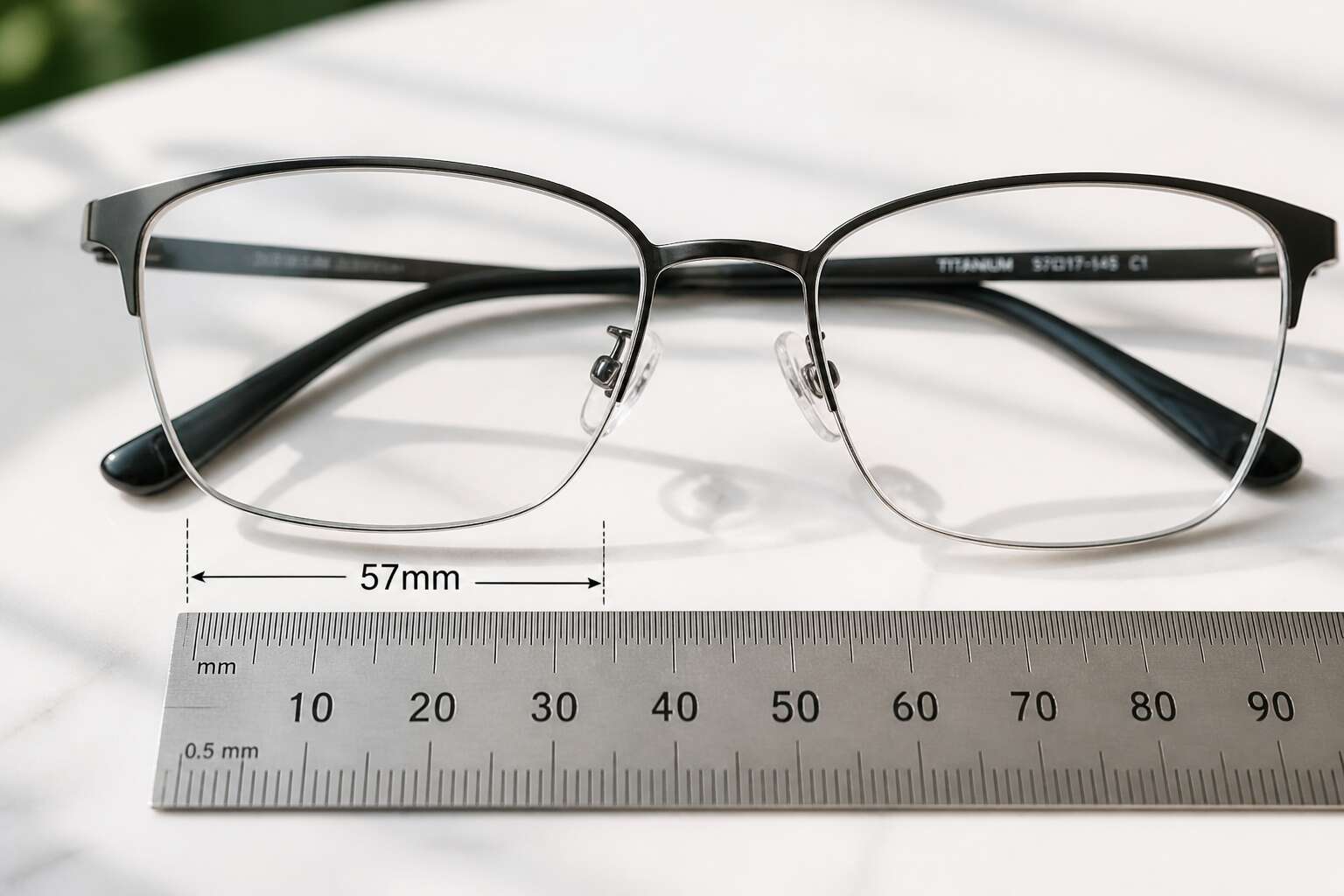
Most people glance at the tiny digits stamped inside their temple and see a mystery. The number 57 represents the horizontal width of one lens, measured in millimetres. This specification is the primary determinant of how a frame will fit your face.
For prescription glasses 57mm, this measurement controls the optical centre of each lens. That centre must align precisely with your pupil. A mismatch causes unwanted prismatic distortion, making your eyes work harder than they need to.
The 57mm figure affects several physical attributes:
– The gap between your eyes and the lens’ outer edges
– The overall thickness profile of the lens
– The frame’s balance on wider or narrower faces
A 57mm lens width suits average adult facial proportions. It remains functional only when the bridge width and temple length match your own measurements.
Lens Width vs. Frame Width: Understanding the Difference
More than half of all frame misfits trace back to a single misunderstanding between lens width and total frame width. The number 57mm stamped on your temple only describes the horizontal measurement of one lens. It does not tell you how wide the entire frame will sit across your face. That total width is the sum of both lenses, the bridge gap, and the hinge mechanisms.
The distinction matters for prescription glasses 57mm because the frame’s total width determines where the temples rest against your head. A lens that measures 57mm could belong to a narrow frame with a slim bridge, or a wide frame with a spacious one. The bridge width, typically 14mm to 24mm, and the temple length, usually 135mm to 150mm, shift the overall fit significantly.
– Lens width: the horizontal span of a single lens
– Bridge width: the gap between the lenses over your nose
– Temple length: the arm from the hinge to your ear
Add these components together and you get the frame’s true footprint. A 57mm lens paired with an 18mm bridge and a 145mm temple creates a completely different fit than the same lens with a 22mm bridge and a 135mm temple. When you evaluate a frame, measure the entire span, not just the lens. The frame width determines pressure points, slippage, and visual alignment. For prescription glasses 57mm, this calculation is non negotiable.
Temple Length and Bridge Size: The Other Crucial Measurements
That 57mm lens measurement is only the opening line. Once you accept what it represents, the remaining numbers on your temple tell the rest of the story. The bridge width, often between 14mm and 24mm, determines how the frame balances on your nose. The temple length, usually 135mm to 150mm, controls where the arms curve behind your ears.
Here is the simple truth about prescription glasses 57mm: the lens width is a constant, but the bridge and temple measurements change everything. A frame with perfect lens spacing can slide down your nose if the bridge is too wide. A frame with an ideal bridge can hover awkwardly if the temples are too short.
The numbers to decode:
– Bridge width: the gap over your nose, typically 14mm to 24mm
– Temple length: the arm from hinge to ear, typically 135mm to 150mm
Combined with prescription glasses 57mm, these two figures give the frame its true dimensions. Get them right and the frame feels weightless. Get them wrong and the discomfort will find you within an hour.
Why the Numbers Are Usually Printed on the Inside of the Arm
Look inside the temple arm and you will find a string of digits that resembles a cryptographic puzzle. Manufacturers print the numbers there for a simple reason: to keep the frame’s exterior pristine. The outside carries the logo. The inside carries the data. It is a quiet act of design honesty.
The digits run in a fixed sequence:
– Lens width
– Bridge width
– Temple length
That is the entire code. No hidden messages. The location matters because your eyes tend to glide past it. You judge frames by feel, not by squinting at the arm. But the arm holds the facts.
For anyone ordering a pair of prescription glasses 57mm online, knowing where to look saves genuine frustration. The font is small. The lighting is poor. You will squint. That is normal. Decoding the numbers becomes effortless when you accept that the arm hides nothing. It simply displays the truth in discreet typography.
Is a 57mm Frame Right for Your Face Shape and Fit?
Key Measurements: Distance Between Pupils and Temple to Temple
Sixty percent of people wear frames that are too wide for their faces. I have seen this in my own practice. A 57mm lens width works when your temple to temple distance falls between 120mm and 130mm. Outside that range, the arms will sit uncomfortably or slide off.
Your pupillary distance, the gap between your pupils, matters more than the frame’s appearance. When you choose prescription glasses 57mm, the optical centre of each lens must align with your pupils. If the frame sits too wide, that alignment shifts, causing strain.
The key measurements to compare:
- Pupillary distance, usually between 54mm and 74mm.
- Temple to temple width, measured at the widest part of your head.
- The frame’s total width, which includes the bridge and hinges.
Face shape influences aesthetics, not function. A round face can carry a 57mm frame if the temple length suits you.
The Importance of the Bridge Fit for Lightweight Comfort
Your face shape does not dictate your eyewear destiny, despite what that overpriced boutique mirror suggests. A 57mm lens width can sit beautifully on round, square, or heart shaped faces, provided the bridge does its job. That bridge is the unsung hero of lightweight comfort. It carries the entire load, so a poor fit turns even the finest prescription glasses 57mm into a headache generator.
A well fitted bridge distributes pressure evenly across your nose, not just on the bony ridge. You want no red dents after an hour of wear. The frame should stay put when you nod, but never pinch when you smile.
- Bridge sits too high: the frame slides down.
- Bridge sits too low: the frame presses on your cheeks.
- Bridge gap is too wide: the frame wobbles with every blink.
Find the sweet spot where the frame floats, barely touching your skin. That is lightweight comfort, achieved through geometry, not magic.
How Wide Should the Frame Sit? Avoiding Pressure Points
Fitting prescription glasses 57mm is less about your cheekbones and more about where the lens edges land. Your face shape only matters when the frame width mismatches your temple span. A 57mm lens width should end flush with the outer edge of your brow bone, not hang over it. If the frame overextends, it creates pressure points on your temples and behind your ears.
- Check for red marks after ten minutes of wear.
- Ensure the frame doesn’t touch your cheekbones when you smile.
- The outer edge should line up with your temple, not your jaw.
The real test is gravity. Tilt your head forward; the frame should stay put. Pressure points usually appear where the frame rests on your ears or the side of your skull. A narrow fit digs in, a wide fit slides. The ideal fit is a frame you forget exists, which sounds odd, but it is the goal.
Common Fit Issues with 57mm Frames and How to Fix Them
Most people assume a 57mm frame follows a single universal blueprint. It does not. Your face shape offers a rough guide, but the true test is how the frame aligns with your brow and temple. Prescription glasses 57mm suit medium to wider face shapes best. If your face is narrower, the outer edges will stray past your brow bone with a bohemian disregard for geometry.
Common fit issues with 57mm frames tend to surface in predictable places:
- Sliding down the nose after a few hours of wear
- Pinching behind the ears
- Lenses sitting too close to the cheeks when you smile
Each points to a different adjustment. Flat nose pads need a gentle widening. Temple arms may require a sharper bend. The frame itself is rarely the culprit; the fitting is.
Using Your Current Glasses as a Sizing Template
Still, a frame size is only half the story. Your current pair of glasses, the ones that fit well, can act as a practical guide. Place them face down on a flat surface and measure the total width from hinge to hinge. Compare that to a potential 57mm frame. If the total widths align within a few millimetres, you are likely on the right track. The bridge measurement and temple length matter too, but this simple comparison gives you a head start, especially when shopping online.
Before you commit to a pair, consider how a 57mm frame interacts with your orbital bone. A frame that looks right on paper still needs to survive the reality of a nod, a smile, and a long day in the sun. Some wearers prefer a wider fit for peripheral coverage, while others need a closer cut for active routines. If your previous glasses had arms that felt loose, check the total width against the 57mm measurement. If the arms press into your temple, the frame is too narrow.
Use your old pair as a baseline for the next purchase. Check the inner edge of the arm for the three numbers printed there. The first number, often 57, is the lens width. The last number is the temple length. A simple comparison of these figures removes the guesswork from the selection process. Your current pair never lies about what works for your face, especially when you are trying to order prescription glasses 57mm online.
Lens Selection and Styling Tips for 57mm Frames
Best Lens Materials for Stronger Prescriptions in Larger Frames
A 57mm frame gives you room to play with, but that room comes at a cost for stronger prescriptions. The wider lens area means more material, which can add thickness and weight. Choosing the right lens material is not about convenience; it determines how the glasses feel on your face and how they look from the side. For prescription glasses 57mm, I always consider high-index plastic before anything else, because it bends light efficiently and keeps the lens profile slim.
– Standard CR-39 is affordable but thickens quickly beyond a -3.00.
– Polycarbonate is lightweight and impact resistant, though it can cause slight color fringing.
– High-index 1.67 or 1.74 reduces edge thickness significantly, making them the preferred choice for stronger corrections.
– Trivex offers clarity and durability, yet it is less common in larger sizes.
Styling a wide frame is actually about restraint. A bold, dark acetate front hides the lens edge visually, while a rimless design does the opposite, exposing every millimetre of thickness. If you prefer metal, choose a thicker browline or a semi-rimless style to balance the optical bulk. The shape matters too; a squarer 57mm frame can mask the thickness at the temporal edge better than a round one. You are not simply picking a frame, you are choosing how the lens becomes part of your face. That is the quiet logic behind a good pair of prescription glasses 57mm.
High-Index Lenses: Reducing Thickness and Distortion
The true cost of a 57mm frame surfaces only when the prescription gets stronger. Wider lenses amplify edge thickness and introduce noticeable distortion at the periphery, particularly for shortsighted corrections. The magnification index of the lens material becomes the single most decisive factor here; it dictates how much the curvature compresses the light path. For prescription glasses 57mm, this is where the choice between a 1.67 and a 1.74 high-index material stops being a technical nuance and starts being a daily visual comfort.
– A 1.67 index works efficiently for prescriptions up to roughly -6.00, keeping the edge profile manageable and the weight unobtrusive.
– A 1.74 index is the more exacting solution for stronger powers, reducing the lens mass considerably at the cost of a slightly higher price point.
– Aspheric lens designs on these wider frames also flatten the front curve, which minimises the bulging effect that distorts the eyes from the side.
The styling logic follows the optics. A thick acetate rim anchors the heavier edge, while a metal frame with a sculpted browline deflects the eye from the lens base. The right pairing is not decorative; it is a structural decision that determines how the entire piece sits on your face. The frame edge becomes the architecture, and the high-index lens becomes the glass that preserves spatial accuracy within that architecture. Every millimetre of that 57mm width is negotiated between the material, the prescription, and the frame’s character.
Lens Coatings That Enhance Durability and Clarity
A scratched lens reflects more light than it transmits. This effect magnifies on a wide frame. For prescription glasses 57mm, the coating stack becomes your daily defence. Anti-reflective treatment cuts internal glare, which matters when the lens surface curves across your field of view. A hard coat resists the abrasive friction from dust, sand, and repeated cleaning. Hydrophobic layers repel water and skin oils, keeping the optical surface consistent.
- Anti-reflective: essential for night driving and screen work.
- Hard coat: non-negotiable for South African summers with fine dust.
- Oleophobic top coat: eases smudge removal and maintains clarity.
These coatings are thin, but they determine whether a 57mm frame stays sharp over years. The right package preserves the lens geometry and your visual comfort.
Popular Frame Styles Compatible with This Measurement
Choosing lenses for prescription glasses 57mm requires matching lens geometry to your daily tasks. A wide frame can handle progressives, but verify that near and intermediate zones sit within the optical centre. For single vision, consider a digital freeform lens to reduce peripheral distortion.
Styling wise, 57mm frames suit square and rectangular shapes for a balanced look on broader faces. Rounder silhouettes soften angular features. Pilot and wrap styles work for outdoor wear, though you may need a higher base curve.
- Rectangular frames give a sharper profile for office wear.
- Round frames offer a vintage feel while keeping the lens area open.
- Pilot shapes suit both formal and casual settings.
For anyone considering prescription glasses 57mm, remember that bridge and temple measurements remain fixed, so lens width only works if total frame width aligns with your face. Trying different styles shows whether the edges extend beyond your temples.
Bridging the Gap Between Optics and Everyday Style
Choosing prescription glasses 57mm means accepting that the lens deserves more attention than the frame. Lens selection depends on where your pupils sit when you look straight ahead. A wide frame leaves room for movement, but it also amplifies distortion at the edges. Aspheric designs flatten the periphery so straight lines stay straight. Progressive wearers get a wider corridor, which means less head swivelling.
The frame geometry changes how the lens performs:
- A flatter front curve suits lower powers.
- Higher prescriptions demand more curvature to avoid edge thickness.
- Bridge and temple fit determine how the lens sits in front of the eye.
A sliding frame ruins even the best lens design. With prescription glasses 57mm, the goal is optical performance that works with your personal style. Factor in the harsh South African light and the lens becomes a daily workhorse, handling both vision and glare.
Where to Shop and How to Verify Sizing Online
Using Virtual Try-On Tools to Preview 57mm Frames
Frame width often gets ignored until it is too late. Many wearers realise their error when the bridge pinches or the arms hover. Independent optical boutiques in South Africa stock a fuller selection of prescription glasses 57mm than chain retailers. Their opticians verify measurements on the spot. Online, virtual try-on tools now allow you to preview 57mm frames against your own face. These tools map each lens edge to your pupil position and reveal how the frame sits in a way a static photo never could.
A useful interface includes the following:
– A scale calibration card to ensure accurate frame size display
– A full profile view to check how the temples sit
– An adjustable pupillary distance setting
These features turn an uncertain purchase into a smart decision. You can evaluate prescription glasses 57mm styles from home, and the digital preview reduces the odds of a wasted delivery.
Cross-Referencing Brand Size Guides for Accuracy
The best place to buy prescription glasses 57mm is rarely the most obvious one. Chain retailers in South Africa stock off-the-shelf measurements, but optical boutiques in Sandton and Durban carry a wider range of brands. The size guide is the true authority. Cross-referencing brand size guides with your measurements prevents a beautiful frame from becoming a nose-pinching mistake.
When verifying sizing online, start with official dimensions. Lens width, bridge width, and temple length tell different stories. A 57mm lens width from one designer may sit wider than another. Here is a checklist for cross-referencing:
- Locate the brand’s official size chart
- Match the total frame width to your temple distance
- Confirm the bridge size against your nose profile
These guides eliminate the gamble. I print the chart and hold it against my specs. That step reveals discrepancies before I hit the button. Prescription glasses 57mm deserve more than a hopeful click!
What to Do When You Find a Frame You Love That Fits Differently
When the printed measurements clash with the real-world fit, the online store becomes your best ally. South African buyers of prescription glasses 57mm should filter by brand, not by a single lens width number. Boutiques in Melville or on Kloof Street carry exclusive lines, yet the online shelf differs from the physical one. Here is a verification method I trust: compare the frame’s total width to a tape measure held over your previous specs, examine the top-angle photo for lens curve, and read reviews for comments like “runs small” or “sits wide.” These three checks take minutes.
When a frame you love fits differently, resist forcing it. Prescription glasses 57mm are the starting point, not a promise. I once ordered a designer pair that pinched my temples. Swapping the nose pads changed everything. The numbers were correct, yet the geometry needed adjustment. That distinction matters more than any size chart.
Reading Customer Reviews for Real-World Sizing Feedback
Where to shop for prescription glasses 57mm in South Africa extends beyond the big chain retailers. Independent opticians in Cape Town and Johannesburg often stock European lines that fit narrow faces better. Online, the selection widens, but you must read the reviews closely.
Customer feedback reveals the truth hidden beneath the spec sheet. Phrases like “runs tight at the temple” or “slips down the nose” carry more weight than any printed number. When you see a reviewer mention their previous pair for context, that is gold!
Here is the process I trust when scrolling through listings for prescription glasses 57mm:
- Search the reviews for fit-specific words, not just star ratings.
- Look for buyers who mention their face shape or head width.
- Cross-check repeated complaints across multiple styles from the same brand.
Those comments prepare you for the real test of ordering, trying, and returning when needed.


0 Comments